README_EN.md
| comments | difficulty | edit_url | tags | |||
|---|---|---|---|---|---|---|
| true | Medium | https://github.com/doocs/leetcode/edit/main/solution/0000-0099/0063.Unique%20Paths%20II/README_EN.md |
|
63. Unique Paths II
Description
You are given an m x n integer array grid. There is a robot initially located at the top-left corner (i.e., grid[0][0]). The robot tries to move to the bottom-right corner (i.e., grid[m - 1][n - 1]). The robot can only move either down or right at any point in time.
An obstacle and space are marked as 1 or 0 respectively in grid. A path that the robot takes cannot include any square that is an obstacle.
Return the number of possible unique paths that the robot can take to reach the bottom-right corner.
The testcases are generated so that the answer will be less than or equal to 2 * 109.
Example 1:
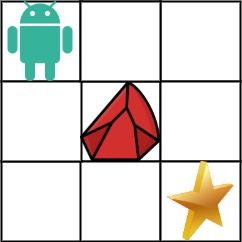
Input: obstacleGrid = [[0,0,0],[0,1,0],[0,0,0]]
Output: 2
Explanation: There is one obstacle in the middle of the 3x3 grid above.
There are two ways to reach the bottom-right corner:
1. Right -> Right -> Down -> Down
2. Down -> Down -> Right -> Right
Example 2:

Input: obstacleGrid = [[0,1],[0,0]]
Output: 1
Constraints:
m == obstacleGrid.lengthn == obstacleGrid[i].length1 <= m, n <= 100obstacleGrid[i][j]is0or1.
Solutions
Solution 1: Memoization Search
We design a function \textit{dfs}(i, j) to represent the number of paths from the grid (i, j) to the grid (m - 1, n - 1). Here, m and n are the number of rows and columns of the grid, respectively.
The execution process of the function \textit{dfs}(i, j) is as follows:
- If
i \ge morj \ge n, or\textit{obstacleGrid}[i][j] = 1, the number of paths is0; - If
i = m - 1andj = n - 1, the number of paths is1; - Otherwise, the number of paths is
\textit{dfs}(i + 1, j) + \textit{dfs}(i, j + 1).
To avoid redundant calculations, we can use memoization.
The time complexity is O(m \times n), and the space complexity is O(m \times n). Here, m and n are the number of rows and columns of the grid, respectively.
Python3
class Solution:
    def uniquePathsWithObstacles(self, obstacleGrid: List[List[int]]) -> int:
        @cache
        def dfs(i: int, j: int) -> int:
            if i >= m or j >= n or obstacleGrid[i][j]:
                return 0
            if i == m - 1 and j == n - 1:
                return 1
            return dfs(i + 1, j) + dfs(i, j + 1)

        m, n = len(obstacleGrid), len(obstacleGrid[0])
        return dfs(0, 0)
Java
class Solution {
    private Integer[][] f;
    private int[][] obstacleGrid;
    private int m;
    private int n;

    public int uniquePathsWithObstacles(int[][] obstacleGrid) {
        m = obstacleGrid.length;
        n = obstacleGrid[0].length;
        this.obstacleGrid = obstacleGrid;
        f = new Integer[m][n];
        return dfs(0, 0);
    }

    private int dfs(int i, int j) {
        if (i >= m || j >= n || obstacleGrid[i][j] == 1) {
            return 0;
        }
        if (i == m - 1 && j == n - 1) {
            return 1;
        }
        if (f[i][j] == null) {
            f[i][j] = dfs(i + 1, j) + dfs(i, j + 1);
        }
        return f[i][j];
    }
}
C++
class Solution {
public:
    int uniquePathsWithObstacles(vector<vector<int>>& obstacleGrid) {
        int m = obstacleGrid.size(), n = obstacleGrid[0].size();
        vector<vector<int>> f(m, vector<int>(n, -1));
        auto dfs = [&](this auto&& dfs, int i, int j) {
            if (i >= m || j >= n || obstacleGrid[i][j]) {
                return 0;
            }
            if (i == m - 1 && j == n - 1) {
                return 1;
            }
            if (f[i][j] == -1) {
                f[i][j] = dfs(i + 1, j) + dfs(i, j + 1);
            }
            return f[i][j];
        };
        return dfs(0, 0);
    }
};
Go
func uniquePathsWithObstacles(obstacleGrid [][]int) int {
	m, n := len(obstacleGrid), len(obstacleGrid[0])
	f := make([][]int, m)
	for i := range f {
		f[i] = make([]int, n)
		for j := range f[i] {
			f[i][j] = -1
		}
	}
	var dfs func(i, j int) int
	dfs = func(i, j int) int {
		if i >= m || j >= n || obstacleGrid[i][j] == 1 {
			return 0
		}
		if i == m-1 && j == n-1 {
			return 1
		}
		if f[i][j] == -1 {
			f[i][j] = dfs(i+1, j) + dfs(i, j+1)
		}
		return f[i][j]
	}
	return dfs(0, 0)
}
TypeScript
function uniquePathsWithObstacles(obstacleGrid: number[][]): number {
    const m = obstacleGrid.length;
    const n = obstacleGrid[0].length;
    const f: number[][] = Array.from({ length: m }, () => Array(n).fill(-1));
    const dfs = (i: number, j: number): number => {
        if (i >= m || j >= n || obstacleGrid[i][j] === 1) {
            return 0;
        }
        if (i === m - 1 && j === n - 1) {
            return 1;
        }
        if (f[i][j] === -1) {
            f[i][j] = dfs(i + 1, j) + dfs(i, j + 1);
        }
        return f[i][j];
    };
    return dfs(0, 0);
}
Rust
impl Solution {
    pub fn unique_paths_with_obstacles(obstacle_grid: Vec<Vec<i32>>) -> i32 {
        let m = obstacle_grid.len();
        let n = obstacle_grid[0].len();
        let mut f = vec![vec![-1; n]; m];
        Self::dfs(0, 0, &obstacle_grid, &mut f)
    }

    fn dfs(i: usize, j: usize, obstacle_grid: &Vec<Vec<i32>>, f: &mut Vec<Vec<i32>>) -> i32 {
        let m = obstacle_grid.len();
        let n = obstacle_grid[0].len();
        if i >= m || j >= n || obstacle_grid[i][j] == 1 {
            return 0;
        }
        if i == m - 1 && j == n - 1 {
            return 1;
        }
        if f[i][j] != -1 {
            return f[i][j];
        }
        let down = Self::dfs(i + 1, j, obstacle_grid, f);
        let right = Self::dfs(i, j + 1, obstacle_grid, f);
        f[i][j] = down + right;
        f[i][j]
    }
}
JavaScript
/**
 * @param {number[][]} obstacleGrid
 * @return {number}
 */
var uniquePathsWithObstacles = function (obstacleGrid) {
    const m = obstacleGrid.length;
    const n = obstacleGrid[0].length;
    const f = Array.from({ length: m }, () => Array(n).fill(-1));
    const dfs = (i, j) => {
        if (i >= m || j >= n || obstacleGrid[i][j] === 1) {
            return 0;
        }
        if (i === m - 1 && j === n - 1) {
            return 1;
        }
        if (f[i][j] === -1) {
            f[i][j] = dfs(i + 1, j) + dfs(i, j + 1);
        }
        return f[i][j];
    };
    return dfs(0, 0);
};
Solution 2: Dynamic Programming
We can use a dynamic programming approach by defining a 2D array f, where f[i][j] represents the number of paths from the grid (0,0) to the grid (i,j).
We first initialize all values in the first column and the first row of f, then traverse the other rows and columns with two cases:
- If
\textit{obstacleGrid}[i][j] = 1, it means the number of paths is0, sof[i][j] = 0; - If
\textit{obstacleGrid}[i][j] = 0, thenf[i][j] = f[i - 1][j] + f[i][j - 1].
Finally, return f[m - 1][n - 1].
The time complexity is O(m \times n), and the space complexity is O(m \times n). Here, m and n are the number of rows and columns of the grid, respectively.
Python3
class Solution:
    def uniquePathsWithObstacles(self, obstacleGrid: List[List[int]]) -> int:
        m, n = len(obstacleGrid), len(obstacleGrid[0])
        f = [[0] * n for _ in range(m)]
        for i in range(m):
            if obstacleGrid[i][0] == 1:
                break
            f[i][0] = 1
        for j in range(n):
            if obstacleGrid[0][j] == 1:
                break
            f[0][j] = 1
        for i in range(1, m):
            for j in range(1, n):
                if obstacleGrid[i][j] == 0:
                    f[i][j] = f[i - 1][j] + f[i][j - 1]
        return f[-1][-1]
Java
class Solution {
    public int uniquePathsWithObstacles(int[][] obstacleGrid) {
        int m = obstacleGrid.length, n = obstacleGrid[0].length;
        int[][] f = new int[m][n];
        for (int i = 0; i < m && obstacleGrid[i][0] == 0; ++i) {
            f[i][0] = 1;
        }
        for (int j = 0; j < n && obstacleGrid[0][j] == 0; ++j) {
            f[0][j] = 1;
        }
        for (int i = 1; i < m; ++i) {
            for (int j = 1; j < n; ++j) {
                if (obstacleGrid[i][j] == 0) {
                    f[i][j] = f[i - 1][j] + f[i][j - 1];
                }
            }
        }
        return f[m - 1][n - 1];
    }
}
C++
class Solution {
public:
    int uniquePathsWithObstacles(vector<vector<int>>& obstacleGrid) {
        int m = obstacleGrid.size(), n = obstacleGrid[0].size();
        vector<vector<int>> f(m, vector<int>(n));
        for (int i = 0; i < m && obstacleGrid[i][0] == 0; ++i) {
            f[i][0] = 1;
        }
        for (int j = 0; j < n && obstacleGrid[0][j] == 0; ++j) {
            f[0][j] = 1;
        }
        for (int i = 1; i < m; ++i) {
            for (int j = 1; j < n; ++j) {
                if (obstacleGrid[i][j] == 0) {
                    f[i][j] = f[i - 1][j] + f[i][j - 1];
                }
            }
        }
        return f[m - 1][n - 1];
    }
};
Go
func uniquePathsWithObstacles(obstacleGrid [][]int) int {
	m, n := len(obstacleGrid), len(obstacleGrid[0])
	f := make([][]int, m)
	for i := 0; i < m; i++ {
		f[i] = make([]int, n)
	}
	for i := 0; i < m && obstacleGrid[i][0] == 0; i++ {
		f[i][0] = 1
	}
	for j := 0; j < n && obstacleGrid[0][j] == 0; j++ {
		f[0][j] = 1
	}
	for i := 1; i < m; i++ {
		for j := 1; j < n; j++ {
			if obstacleGrid[i][j] == 0 {
				f[i][j] = f[i-1][j] + f[i][j-1]
			}
		}
	}
	return f[m-1][n-1]
}
TypeScript
function uniquePathsWithObstacles(obstacleGrid: number[][]): number {
    const m = obstacleGrid.length;
    const n = obstacleGrid[0].length;
    const f = Array.from({ length: m }, () => Array(n).fill(0));
    for (let i = 0; i < m; i++) {
        if (obstacleGrid[i][0] === 1) {
            break;
        }
        f[i][0] = 1;
    }
    for (let i = 0; i < n; i++) {
        if (obstacleGrid[0][i] === 1) {
            break;
        }
        f[0][i] = 1;
    }
    for (let i = 1; i < m; i++) {
        for (let j = 1; j < n; j++) {
            if (obstacleGrid[i][j] === 1) {
                continue;
            }
            f[i][j] = f[i - 1][j] + f[i][j - 1];
        }
    }
    return f[m - 1][n - 1];
}
Rust
impl Solution {
    pub fn unique_paths_with_obstacles(obstacle_grid: Vec<Vec<i32>>) -> i32 {
        let m = obstacle_grid.len();
        let n = obstacle_grid[0].len();
        let mut f = vec![vec![0; n]; m];
        for i in 0..n {
            if obstacle_grid[0][i] == 1 {
                break;
            }
            f[0][i] = 1;
        }
        for i in 0..m {
            if obstacle_grid[i][0] == 1 {
                break;
            }
            f[i][0] = 1;
        }
        for i in 1..m {
            for j in 1..n {
                if obstacle_grid[i][j] == 1 {
                    continue;
                }
                f[i][j] = f[i - 1][j] + f[i][j - 1];
            }
        }
        f[m - 1][n - 1]
    }
}
JavaScript
/**
 * @param {number[][]} obstacleGrid
 * @return {number}
 */
var uniquePathsWithObstacles = function (obstacleGrid) {
    const m = obstacleGrid.length;
    const n = obstacleGrid[0].length;
    const f = Array.from({ length: m }, () => Array(n).fill(0));
    for (let i = 0; i < m; i++) {
        if (obstacleGrid[i][0] === 1) {
            break;
        }
        f[i][0] = 1;
    }
    for (let i = 0; i < n; i++) {
        if (obstacleGrid[0][i] === 1) {
            break;
        }
        f[0][i] = 1;
    }
    for (let i = 1; i < m; i++) {
        for (let j = 1; j < n; j++) {
            if (obstacleGrid[i][j] === 1) {
                continue;
            }
            f[i][j] = f[i - 1][j] + f[i][j - 1];
        }
    }
    return f[m - 1][n - 1];
};