mirror of https://github.com/doocs/leetcode.git
|
…
|
||
|---|---|---|
| .. | ||
| images | ||
| README.md | ||
| README_EN.md | ||
| Solution.cpp | ||
| Solution.cs | ||
| Solution.go | ||
| Solution.java | ||
| Solution.py | ||
| Solution.rs | ||
README_EN.md
| comments | difficulty | edit_url | tags | |||||
|---|---|---|---|---|---|---|---|---|
| true | Hard | https://github.com/doocs/leetcode/edit/main/solution/0000-0099/0085.Maximal%20Rectangle/README_EN.md |
|
85. Maximal Rectangle
Description
Given a rows x cols binary matrix filled with 0's and 1's, find the largest rectangle containing only 1's and return its area.
Example 1:
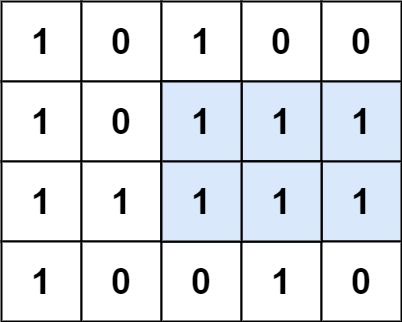
Input: matrix = [["1","0","1","0","0"],["1","0","1","1","1"],["1","1","1","1","1"],["1","0","0","1","0"]]
Output: 6
Explanation: The maximal rectangle is shown in the above picture.
Example 2:
Input: matrix = [["0"]]
Output: 0
Example 3:
Input: matrix = [["1"]]
Output: 1
Constraints:
rows == matrix.lengthcols == matrix[i].length1 <= row, cols <= 200matrix[i][j]is'0'or'1'.
Solutions
Solution 1: Monotonic Stack
We treat each row as the base of the histogram, and calculate the maximum area of the histogram for each row.
The time complexity is O(m \times n), where m represents the number of rows in matrix, and n represents the number of columns in matrix.
Python3
class Solution:
    def maximalRectangle(self, matrix: List[List[str]]) -> int:
        heights = [0] * len(matrix[0])
        ans = 0
        for row in matrix:
            for j, v in enumerate(row):
                if v == "1":
                    heights[j] += 1
                else:
                    heights[j] = 0
            ans = max(ans, self.largestRectangleArea(heights))
        return ans

    def largestRectangleArea(self, heights: List[int]) -> int:
        n = len(heights)
        stk = []
        left = [-1] * n
        right = [n] * n
        for i, h in enumerate(heights):
            while stk and heights[stk[-1]] >= h:
                stk.pop()
            if stk:
                left[i] = stk[-1]
            stk.append(i)
        stk = []
        for i in range(n - 1, -1, -1):
            h = heights[i]
            while stk and heights[stk[-1]] >= h:
                stk.pop()
            if stk:
                right[i] = stk[-1]
            stk.append(i)
        return max(h * (right[i] - left[i] - 1) for i, h in enumerate(heights))
Java
class Solution {
    public int maximalRectangle(char[][] matrix) {
        int n = matrix[0].length;
        int[] heights = new int[n];
        int ans = 0;
        for (var row : matrix) {
            for (int j = 0; j < n; ++j) {
                if (row[j] == '1') {
                    heights[j] += 1;
                } else {
                    heights[j] = 0;
                }
            }
            ans = Math.max(ans, largestRectangleArea(heights));
        }
        return ans;
    }

    private int largestRectangleArea(int[] heights) {
        int res = 0, n = heights.length;
        Deque<Integer> stk = new ArrayDeque<>();
        int[] left = new int[n];
        int[] right = new int[n];
        Arrays.fill(right, n);
        for (int i = 0; i < n; ++i) {
            while (!stk.isEmpty() && heights[stk.peek()] >= heights[i]) {
                right[stk.pop()] = i;
            }
            left[i] = stk.isEmpty() ? -1 : stk.peek();
            stk.push(i);
        }
        for (int i = 0; i < n; ++i) {
            res = Math.max(res, heights[i] * (right[i] - left[i] - 1));
        }
        return res;
    }
}
C++
class Solution {
public:
    int maximalRectangle(vector<vector<char>>& matrix) {
        int n = matrix[0].size();
        vector<int> heights(n);
        int ans = 0;
        for (auto& row : matrix) {
            for (int j = 0; j < n; ++j) {
                if (row[j] == '1')
                    ++heights[j];
                else
                    heights[j] = 0;
            }
            ans = max(ans, largestRectangleArea(heights));
        }
        return ans;
    }

    int largestRectangleArea(vector<int>& heights) {
        int res = 0, n = heights.size();
        stack<int> stk;
        vector<int> left(n, -1);
        vector<int> right(n, n);
        for (int i = 0; i < n; ++i) {
            while (!stk.empty() && heights[stk.top()] >= heights[i]) {
                right[stk.top()] = i;
                stk.pop();
            }
            if (!stk.empty()) left[i] = stk.top();
            stk.push(i);
        }
        for (int i = 0; i < n; ++i)
            res = max(res, heights[i] * (right[i] - left[i] - 1));
        return res;
    }
};
Go
func maximalRectangle(matrix [][]byte) int {
	n := len(matrix[0])
	heights := make([]int, n)
	ans := 0
	for _, row := range matrix {
		for j, v := range row {
			if v == '1' {
				heights[j]++
			} else {
				heights[j] = 0
			}
		}
		ans = max(ans, largestRectangleArea(heights))
	}
	return ans
}

func largestRectangleArea(heights []int) int {
	res, n := 0, len(heights)
	var stk []int
	left, right := make([]int, n), make([]int, n)
	for i := range right {
		right[i] = n
	}
	for i, h := range heights {
		for len(stk) > 0 && heights[stk[len(stk)-1]] >= h {
			right[stk[len(stk)-1]] = i
			stk = stk[:len(stk)-1]
		}
		if len(stk) > 0 {
			left[i] = stk[len(stk)-1]
		} else {
			left[i] = -1
		}
		stk = append(stk, i)
	}
	for i, h := range heights {
		res = max(res, h*(right[i]-left[i]-1))
	}
	return res
}
Rust
impl Solution {
    #[allow(dead_code)]
    pub fn maximal_rectangle(matrix: Vec<Vec<char>>) -> i32 {
        let n = matrix[0].len();
        let mut heights = vec![0; n];
        let mut ret = -1;

        for row in &matrix {
            Self::array_builder(row, &mut heights);
            ret = std::cmp::max(ret, Self::largest_rectangle_area(heights.clone()));
        }

        ret
    }

    /// Helper function, build the heights array according to the input
    #[allow(dead_code)]
    fn array_builder(input: &Vec<char>, heights: &mut Vec<i32>) {
        for (i, &c) in input.iter().enumerate() {
            heights[i] += match c {
                '1' => 1,
                '0' => {
                    heights[i] = 0;
                    0
                }
                _ => panic!("This is impossible"),
            };
        }
    }

    /// Helper function, see: https://leetcode.com/problems/largest-rectangle-in-histogram/ for details
    #[allow(dead_code)]
    fn largest_rectangle_area(heights: Vec<i32>) -> i32 {
        let n = heights.len();
        let mut left = vec![-1; n];
        let mut right = vec![-1; n];
        let mut stack: Vec<(usize, i32)> = Vec::new();
        let mut ret = -1;

        // Build left vector
        for (i, h) in heights.iter().enumerate() {
            while !stack.is_empty() && stack.last().unwrap().1 >= *h {
                stack.pop();
            }
            if stack.is_empty() {
                left[i] = -1;
            } else {
                left[i] = stack.last().unwrap().0 as i32;
            }
            stack.push((i, *h));
        }

        stack.clear();

        // Build right vector
        for (i, h) in heights.iter().enumerate().rev() {
            while !stack.is_empty() && stack.last().unwrap().1 >= *h {
                stack.pop();
            }
            if stack.is_empty() {
                right[i] = n as i32;
            } else {
                right[i] = stack.last().unwrap().0 as i32;
            }
            stack.push((i, *h));
        }

        // Calculate the max area
        for (i, h) in heights.iter().enumerate() {
            ret = std::cmp::max(ret, (right[i] - left[i] - 1) * *h);
        }

        ret
    }
}
C#
using System;
using System.Collections.Generic;
using System.Linq;

public class Solution {
    private int MaximalRectangleHistagram(int[] height) {
        var stack = new Stack<int>();
        var result = 0;
        var i = 0;
        while (i < height.Length || stack.Any())
        {
            if (!stack.Any() || (i < height.Length && height[stack.Peek()] < height[i]))
            {
                stack.Push(i);
                ++i;
            }
            else
            {
                var previousIndex = stack.Pop();
                var area = height[previousIndex] * (stack.Any() ? (i - stack.Peek() - 1) : i);
                result = Math.Max(result, area);
            }
        }

        return result;
    }

    public int MaximalRectangle(char[][] matrix) {
        var lenI = matrix.Length;
        var lenJ = lenI == 0 ? 0 : matrix[0].Length;
        var height = new int[lenJ];
        var result = 0;
        for (var i = 0; i < lenI; ++i)
        {
            for (var j = 0; j < lenJ; ++j)
            {
                if (matrix[i][j] == '1')
                {
                    ++height[j];
                }
                else
                {
                    height[j] = 0;
                }
            }
            result = Math.Max(result, MaximalRectangleHistagram(height));
        }
        return result;
    }
}