 1b22bc7303
|
||
|---|---|---|
| .. | ||
| images | ||
| README.md | ||
| README_EN.md | ||
| Solution.cpp | ||
| Solution.cs | ||
| Solution.go | ||
| Solution.java | ||
| Solution.js | ||
| Solution.py | ||
| Solution.ts | ||
README_EN.md
| comments | difficulty | edit_url | tags | ||||
|---|---|---|---|---|---|---|---|
| true | Medium | https://github.com/doocs/leetcode/edit/main/solution/0100-0199/0133.Clone%20Graph/README_EN.md |
|
133. Clone Graph
Description
Given a reference of a node in a connected undirected graph.
Return a deep copy (clone) of the graph.
Each node in the graph contains a value (int) and a list (List[Node]) of its neighbors.
class Node {
    public int val;
    public List<Node> neighbors;
}
Test case format:
For simplicity, each node's value is the same as the node's index (1-indexed). For example, the first node with val == 1, the second node with val == 2, and so on. The graph is represented in the test case using an adjacency list.
An adjacency list is a collection of unordered lists used to represent a finite graph. Each list describes the set of neighbors of a node in the graph.
The given node will always be the first node with val = 1. You must return the copy of the given node as a reference to the cloned graph.
Example 1:
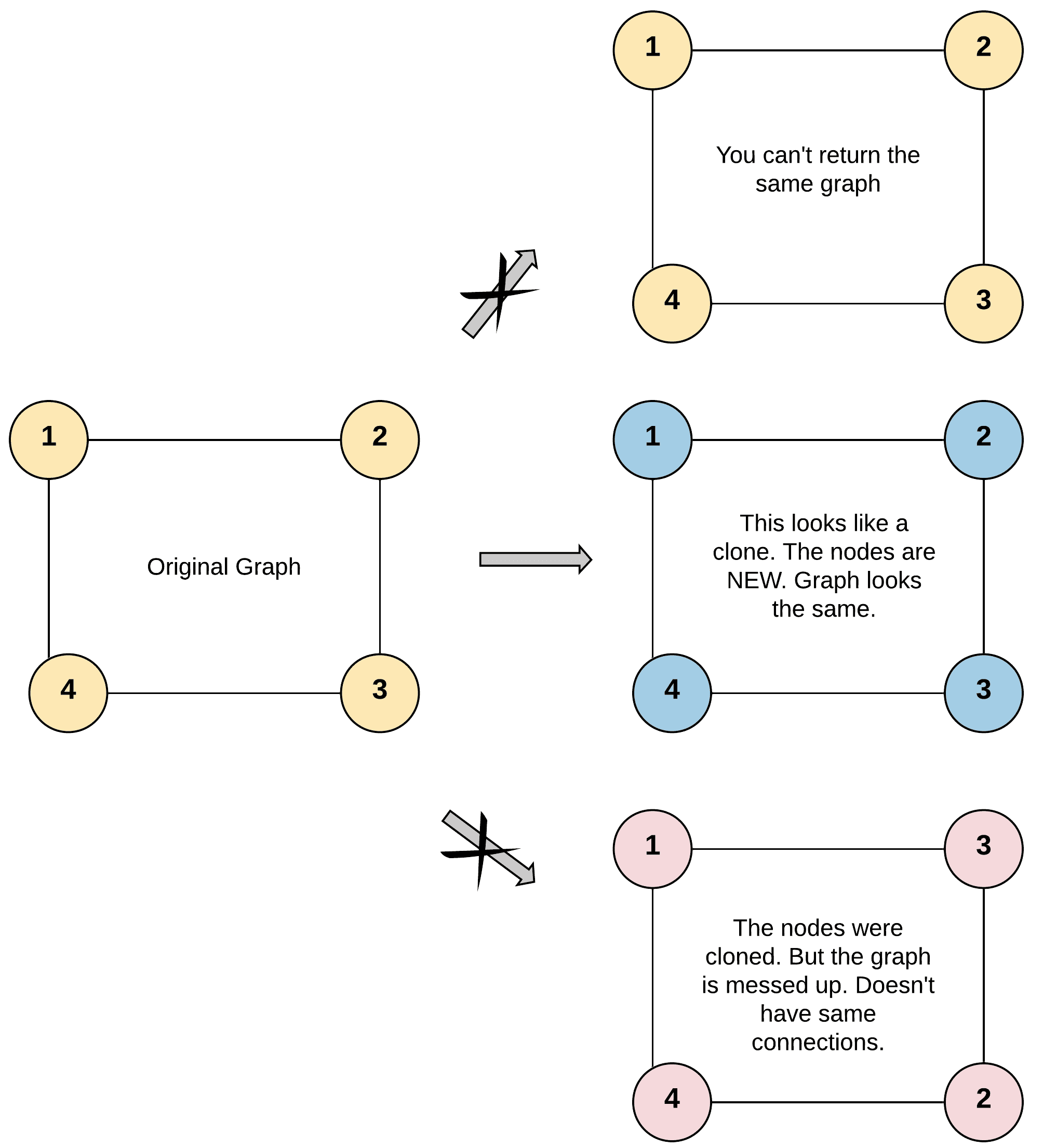
Input: adjList = [[2,4],[1,3],[2,4],[1,3]]
Output: [[2,4],[1,3],[2,4],[1,3]]
Explanation: There are 4 nodes in the graph.
1st node (val = 1)'s neighbors are 2nd node (val = 2) and 4th node (val = 4).
2nd node (val = 2)'s neighbors are 1st node (val = 1) and 3rd node (val = 3).
3rd node (val = 3)'s neighbors are 2nd node (val = 2) and 4th node (val = 4).
4th node (val = 4)'s neighbors are 1st node (val = 1) and 3rd node (val = 3).
Example 2:
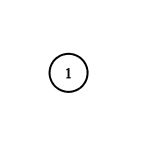
Input: adjList = [[]]
Output: [[]]
Explanation: Note that the input contains one empty list. The graph consists of only one node with val = 1 and it does not have any neighbors.
Example 3:
Input: adjList = []
Output: []
Explanation: This an empty graph, it does not have any nodes.
Constraints:
- The number of nodes in the graph is in the range
[0, 100]. 1 <= Node.val <= 100Node.valis unique for each node.- There are no repeated edges and no self-loops in the graph.
- The Graph is connected and all nodes can be visited starting from the given node.
Solutions
Solution 1: Hash Table + DFS
We use a hash table \textit{g} to record the correspondence between each node in the original graph and its copy, and then perform depth-first search.
We define the function \text{dfs}(node), which returns the copy of the \textit{node}. The process of \text{dfs}(node) is as follows:
- If
\textit{node}is\text{null}, then the return value of\text{dfs}(node)is\text{null}. - If
\textit{node}is in\textit{g}, then the return value of\text{dfs}(node)is\textit{g}[node]. - Otherwise, we create a new node
\textit{cloned}and set the value of\textit{g}[node]to\textit{cloned}. Then, we traverse all the neighbor nodes\textit{nxt}of\textit{node}and add\text{dfs}(nxt)to the neighbor list of\textit{cloned}. - Finally, return
\textit{cloned}.
In the main function, we return \text{dfs}(node).
The time complexity is O(n), and the space complexity is O(n). Here, n is the number of nodes.
Python3
"""
# Definition for a Node.
class Node:
    def __init__(self, val = 0, neighbors = None):
        self.val = val
        self.neighbors = neighbors if neighbors is not None else []
"""

from typing import Optional


class Solution:
    def cloneGraph(self, node: Optional["Node"]) -> Optional["Node"]:
        def dfs(node):
            if node is None:
                return None
            if node in g:
                return g[node]
            cloned = Node(node.val)
            g[node] = cloned
            for nxt in node.neighbors:
                cloned.neighbors.append(dfs(nxt))
            return cloned

        g = defaultdict()
        return dfs(node)
Java
/*
// Definition for a Node.
class Node {
    public int val;
    public List<Node> neighbors;
    public Node() {
        val = 0;
        neighbors = new ArrayList<Node>();
    }
    public Node(int _val) {
        val = _val;
        neighbors = new ArrayList<Node>();
    }
    public Node(int _val, ArrayList<Node> _neighbors) {
        val = _val;
        neighbors = _neighbors;
    }
}
*/

class Solution {
    private Map<Node, Node> g = new HashMap<>();

    public Node cloneGraph(Node node) {
        return dfs(node);
    }

    private Node dfs(Node node) {
        if (node == null) {
            return null;
        }
        Node cloned = g.get(node);
        if (cloned == null) {
            cloned = new Node(node.val);
            g.put(node, cloned);
            for (Node nxt : node.neighbors) {
                cloned.neighbors.add(dfs(nxt));
            }
        }
        return cloned;
    }
}
C++
/*
// Definition for a Node.
class Node {
public:
    int val;
    vector<Node*> neighbors;
    Node() {
        val = 0;
        neighbors = vector<Node*>();
    }
    Node(int _val) {
        val = _val;
        neighbors = vector<Node*>();
    }
    Node(int _val, vector<Node*> _neighbors) {
        val = _val;
        neighbors = _neighbors;
    }
};
*/

class Solution {
public:
    Node* cloneGraph(Node* node) {
        unordered_map<Node*, Node*> g;
        auto dfs = [&](this auto&& dfs, Node* node) -> Node* {
            if (!node) {
                return nullptr;
            }
            if (g.contains(node)) {
                return g[node];
            }
            Node* cloned = new Node(node->val);
            g[node] = cloned;
            for (auto& nxt : node->neighbors) {
                cloned->neighbors.push_back(dfs(nxt));
            }
            return cloned;
        };
        return dfs(node);
    }
};
Go
/**
 * Definition for a Node.
 * type Node struct {
 *     Val int
 *     Neighbors []*Node
 * }
 */

func cloneGraph(node *Node) *Node {
	g := map[*Node]*Node{}
	var dfs func(node *Node) *Node
	dfs = func(node *Node) *Node {
		if node == nil {
			return nil
		}
		if n, ok := g[node]; ok {
			return n
		}
		cloned := &Node{node.Val, []*Node{}}
		g[node] = cloned
		for _, nxt := range node.Neighbors {
			cloned.Neighbors = append(cloned.Neighbors, dfs(nxt))
		}
		return cloned
	}
	return dfs(node)
}
TypeScript
/**
 * Definition for _Node.
 * class _Node {
 *     val: number
 *     neighbors: _Node[]
 *
 *     constructor(val?: number, neighbors?: _Node[]) {
 *         this.val = (val===undefined ? 0 : val)
 *         this.neighbors = (neighbors===undefined ? [] : neighbors)
 *     }
 * }
 *
 */

function cloneGraph(node: _Node | null): _Node | null {
    const g: Map<_Node, _Node> = new Map();
    const dfs = (node: _Node | null): _Node | null => {
        if (!node) {
            return null;
        }
        if (g.has(node)) {
            return g.get(node);
        }
        const cloned = new _Node(node.val);
        g.set(node, cloned);
        for (const nxt of node.neighbors) {
            cloned.neighbors.push(dfs(nxt));
        }
        return cloned;
    };
    return dfs(node);
}
JavaScript
/**
 * // Definition for a _Node.
 * function _Node(val, neighbors) {
 *    this.val = val === undefined ? 0 : val;
 *    this.neighbors = neighbors === undefined ? [] : neighbors;
 * };
 */

/**
 * @param {_Node} node
 * @return {_Node}
 */
var cloneGraph = function (node) {
    const g = new Map();
    const dfs = node => {
        if (!node) {
            return null;
        }
        if (g.has(node)) {
            return g.get(node);
        }
        const cloned = new _Node(node.val);
        g.set(node, cloned);
        for (const nxt of node.neighbors) {
            cloned.neighbors.push(dfs(nxt));
        }
        return cloned;
    };
    return dfs(node);
};
C#
/*
// Definition for a Node.
public class Node {
    public int val;
    public IList<Node> neighbors;

    public Node() {
        val = 0;
        neighbors = new List<Node>();
    }

    public Node(int _val) {
        val = _val;
        neighbors = new List<Node>();
    }

    public Node(int _val, List<Node> _neighbors) {
        val = _val;
        neighbors = _neighbors;
    }
}
*/

public class Solution {
    public Node CloneGraph(Node node) {
        var g = new Dictionary<Node, Node>();
        Node Dfs(Node n) {
            if (n == null) {
                return null;
            }
            if (g.ContainsKey(n)) {
                return g[n];
            }
            var cloned = new Node(n.val);
            g[n] = cloned;
            foreach (var neighbor in n.neighbors) {
                cloned.neighbors.Add(Dfs(neighbor));
            }
            return cloned;
        }
        return Dfs(node);
    }
}