|
…
|
||
|---|---|---|
| .. | ||
| images | ||
| README.md | ||
| README_EN.md | ||
| Solution.cpp | ||
| Solution.go | ||
| Solution.java | ||
| Solution.py | ||
| Solution.ts | ||
README_EN.md
| comments | difficulty | edit_url | tags | |
|---|---|---|---|---|
| true | Easy | https://github.com/doocs/leetcode/edit/main/solution/0900-0999/0941.Valid%20Mountain%20Array/README_EN.md |
|
941. Valid Mountain Array
Description
Given an array of integers arr, return true if and only if it is a valid mountain array.
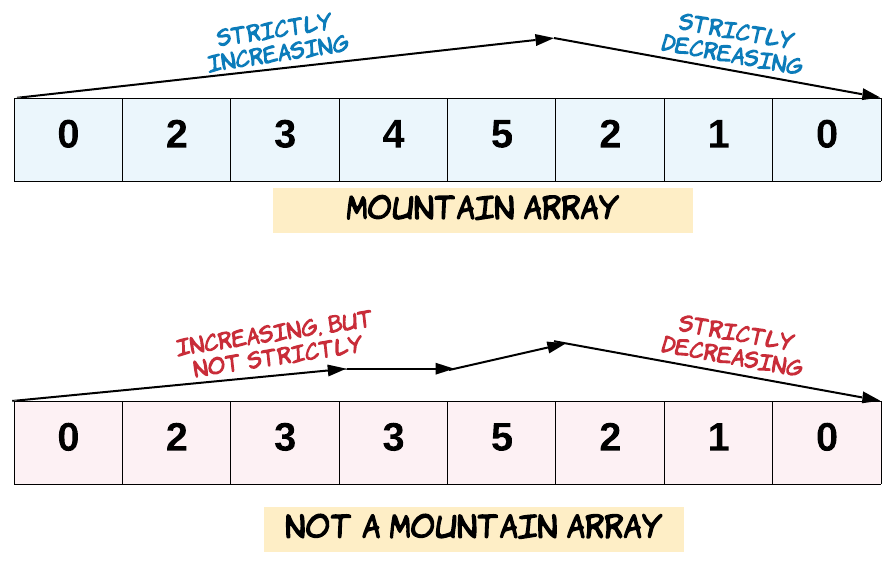
Recall that arr is a mountain array if and only if:
arr.length >= 3- There exists some
iwith0 < i < arr.length - 1such that:arr[0] < arr[1] < ... < arr[i - 1] < arr[i]arr[i] > arr[i + 1] > ... > arr[arr.length - 1]
Example 1:
Input: arr = [2,1]
Output: false
Example 2:
Input: arr = [3,5,5]
Output: false
Example 3:
Input: arr = [0,3,2,1]
Output: true
Constraints:
1 <= arr.length <= 1040 <= arr[i] <= 104
Solutions
Solution 1: Two Pointers
First, we check if the length of the array is less than 3. If it is, then it definitely is not a mountain array, so we return false directly.
Then, we use a pointer i to move from the left end of the array to the right, until we find a position i such that arr[i] > arr[i + 1]. After that, we use a pointer j to move from the right end of the array to the left, until we find a position j such that arr[j] > arr[j - 1]. If the condition i = j is satisfied, then it means that the array arr is a mountain array.
The time complexity is O(n), where n is the length of the array. The space complexity is O(1).
Python3
class Solution:
    def validMountainArray(self, arr: List[int]) -> bool:
        n = len(arr)
        if n < 3:
            return False
        i, j = 0, n - 1
        while i + 1 < n - 1 and arr[i] < arr[i + 1]:
            i += 1
        while j - 1 > 0 and arr[j - 1] > arr[j]:
            j -= 1
        return i == j
Java
class Solution {
    public boolean validMountainArray(int[] arr) {
        int n = arr.length;
        if (n < 3) {
            return false;
        }
        int i = 0, j = n - 1;
        while (i + 1 < n - 1 && arr[i] < arr[i + 1]) {
            ++i;
        }
        while (j - 1 > 0 && arr[j - 1] > arr[j]) {
            --j;
        }
        return i == j;
    }
}
C++
class Solution {
public:
    bool validMountainArray(vector<int>& arr) {
        int n = arr.size();
        if (n < 3) {
            return false;
        }
        int i = 0, j = n - 1;
        while (i + 1 < n - 1 && arr[i] < arr[i + 1]) {
            ++i;
        }
        while (j - 1 > 0 && arr[j - 1] > arr[j]) {
            --j;
        }
        return i == j;
    }
};
Go
func validMountainArray(arr []int) bool {
	n := len(arr)
	if n < 3 {
		return false
	}
	i, j := 0, n-1
	for i+1 < n-1 && arr[i] < arr[i+1] {
		i++
	}
	for j-1 > 0 && arr[j-1] > arr[j] {
		j--
	}
	return i == j
}
TypeScript
function validMountainArray(arr: number[]): boolean {
    const n = arr.length;
    if (n < 3) {
        return false;
    }
    let [i, j] = [0, n - 1];
    while (i + 1 < n - 1 && arr[i] < arr[i + 1]) {
        i++;
    }
    while (j - 1 > 0 && arr[j] < arr[j - 1]) {
        j--;
    }
    return i === j;
}