mirror of https://github.com/doocs/leetcode.git
 9de9346858
|
||
|---|---|---|
| .. | ||
| images | ||
| README.md | ||
| README_EN.md | ||
| Solution.cpp | ||
| Solution.go | ||
| Solution.java | ||
| Solution.py | ||
| Solution.ts | ||
README_EN.md
| comments | difficulty | edit_url | rating | source | tags | |||
|---|---|---|---|---|---|---|---|---|
| true | Medium | https://github.com/doocs/leetcode/edit/main/solution/1200-1299/1256.Encode%20Number/README_EN.md | 1561 | Biweekly Contest 13 Q1 |
|
1256. Encode Number 🔒
Description
Given a non-negative integer num, Return its encoding string.
The encoding is done by converting the integer to a string using a secret function that you should deduce from the following table:
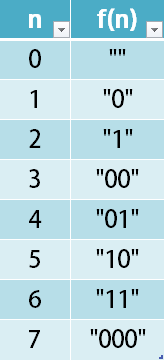
Example 1:
Input: num = 23

Output: "1000"
Example 2:
Input: num = 107

Output: "101100"
Constraints:
<li><code>0 <= num <= 10^9</code></li>
Solutions
Solution 1: Bit Manipulation
We add one to num, then convert it to a binary string and remove the highest bit 1.
The time complexity is O(\log n), and the space complexity is O(\log n). Where n is the size of num.
Python3
class Solution:
    def encode(self, num: int) -> str:
        return bin(num + 1)[3:]
Java
class Solution {
    public String encode(int num) {
        return Integer.toBinaryString(num + 1).substring(1);
    }
}
C++
class Solution {
public:
    string encode(int num) {
        bitset<32> bs(++num);
        string ans = bs.to_string();
        int i = 0;
        while (ans[i] == '0') {
            ++i;
        }
        return ans.substr(i + 1);
    }
};
Go
func encode(num int) string {
	num++
	s := strconv.FormatInt(int64(num), 2)
	return s[1:]
}
TypeScript
function encode(num: number): string {
    ++num;
    let s = num.toString(2);
    return s.slice(1);
}