|
…
|
||
|---|---|---|
| .. | ||
| images | ||
| README.md | ||
| README_EN.md | ||
| Solution.cpp | ||
| Solution.go | ||
| Solution.java | ||
| Solution.js | ||
| Solution.py | ||
| Solution.ts | ||
README_EN.md
| comments | difficulty | edit_url | tags | |||
|---|---|---|---|---|---|---|
| true | Easy | https://github.com/doocs/leetcode/edit/main/solution/0800-0899/0867.Transpose%20Matrix/README_EN.md |
|
867. Transpose Matrix
Description
Given a 2D integer array matrix, return the transpose of matrix.
The transpose of a matrix is the matrix flipped over its main diagonal, switching the matrix's row and column indices.
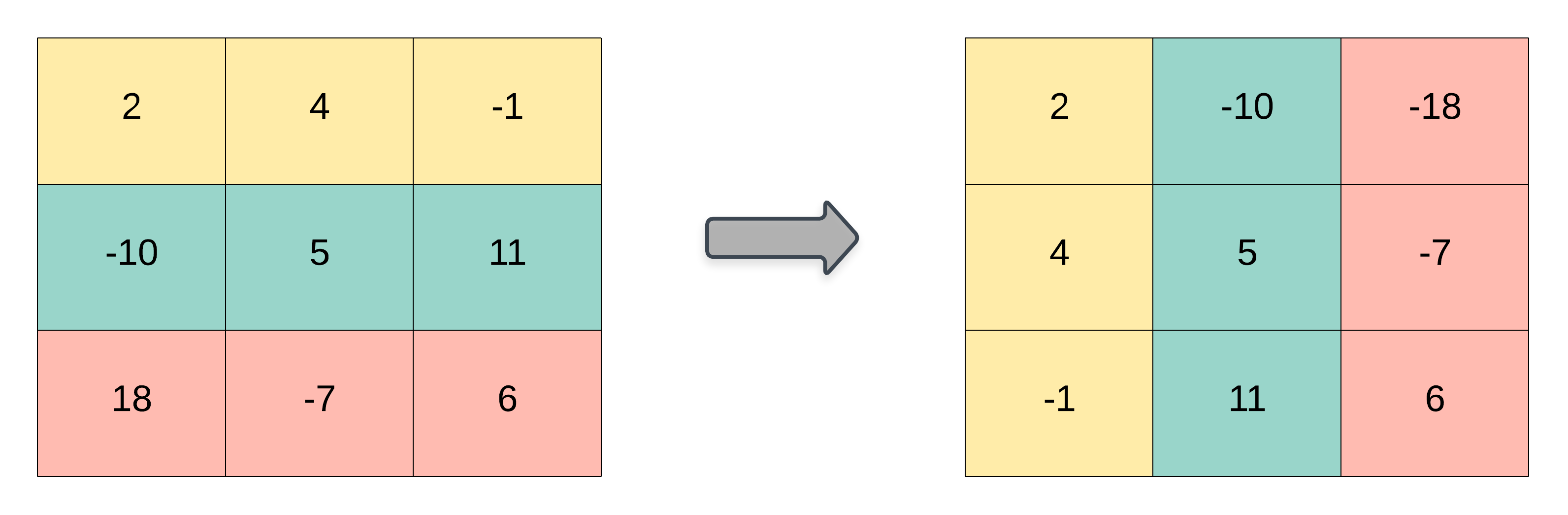
Example 1:
Input: matrix = [[1,2,3],[4,5,6],[7,8,9]]
Output: [[1,4,7],[2,5,8],[3,6,9]]
Example 2:
Input: matrix = [[1,2,3],[4,5,6]]
Output: [[1,4],[2,5],[3,6]]
Constraints:
m == matrix.lengthn == matrix[i].length1 <= m, n <= 10001 <= m * n <= 105-109 <= matrix[i][j] <= 109
Solutions
Solution 1: Simulation
Let m be the number of rows and n be the number of columns in the matrix \textit{matrix}. According to the definition of transpose, the transposed matrix \textit{ans} will have n rows and m columns.
For any position (i, j) in \textit{ans}, it corresponds to the position (j, i) in the matrix \textit{matrix}. Therefore, we traverse each element in the matrix \textit{matrix} and transpose it to the corresponding position in \textit{ans}.
After the traversal, we return \textit{ans}.
The time complexity is O(m \times n), where m and n are the number of rows and columns in the matrix \textit{matrix}, respectively. Ignoring the space consumption of the answer, the space complexity is O(1).
Python3
class Solution:
    def transpose(self, matrix: List[List[int]]) -> List[List[int]]:
        return list(zip(*matrix))
Java
class Solution {
    public int[][] transpose(int[][] matrix) {
        int m = matrix.length, n = matrix[0].length;
        int[][] ans = new int[n][m];
        for (int i = 0; i < n; ++i) {
            for (int j = 0; j < m; ++j) {
                ans[i][j] = matrix[j][i];
            }
        }
        return ans;
    }
}
C++
class Solution {
public:
    vector<vector<int>> transpose(vector<vector<int>>& matrix) {
        int m = matrix.size(), n = matrix[0].size();
        vector<vector<int>> ans(n, vector<int>(m));
        for (int i = 0; i < n; ++i) {
            for (int j = 0; j < m; ++j) {
                ans[i][j] = matrix[j][i];
            }
        }
        return ans;
    }
};
Go
func transpose(matrix [][]int) [][]int {
	m, n := len(matrix), len(matrix[0])
	ans := make([][]int, n)
	for i := range ans {
		ans[i] = make([]int, m)
		for j := range ans[i] {
			ans[i][j] = matrix[j][i]
		}
	}
	return ans
}
TypeScript
function transpose(matrix: number[][]): number[][] {
    const [m, n] = [matrix.length, matrix[0].length];
    const ans: number[][] = Array.from({ length: n }, () => Array(m).fill(0));
    for (let i = 0; i < n; ++i) {
        for (let j = 0; j < m; ++j) {
            ans[i][j] = matrix[j][i];
        }
    }
    return ans;
}
JavaScript
/**
 * @param {number[][]} matrix
 * @return {number[][]}
 */
var transpose = function (matrix) {
    const [m, n] = [matrix.length, matrix[0].length];
    const ans = Array.from({ length: n }, () => Array(m).fill(0));
    for (let i = 0; i < n; ++i) {
        for (let j = 0; j < m; ++j) {
            ans[i][j] = matrix[j][i];
        }
    }
    return ans;
};