mirror of https://github.com/doocs/leetcode.git
14 KiB
14 KiB
| comments | difficulty | edit_url | rating | source | tags | ||||||
|---|---|---|---|---|---|---|---|---|---|---|---|
| true | 中等 | https://github.com/doocs/leetcode/edit/main/solution/1900-1999/1993.Operations%20on%20Tree/README.md | 1861 | 第 60 场双周赛 Q3 |
|
1993. 树上的操作
题目描述
给你一棵 n 个节点的树,编号从 0 到 n - 1 ,以父节点数组 parent 的形式给出,其中 parent[i] 是第 i 个节点的父节点。树的根节点为 0 号节点,所以 parent[0] = -1 ,因为它没有父节点。你想要设计一个数据结构实现树里面对节点的加锁,解锁和升级操作。
数据结构需要支持如下函数:
- Lock:指定用户给指定节点 上锁 ,上锁后其他用户将无法给同一节点上锁。只有当节点处于未上锁的状态下,才能进行上锁操作。
- Unlock:指定用户给指定节点 解锁 ,只有当指定节点当前正被指定用户锁住时,才能执行该解锁操作。
- Upgrade:指定用户给指定节点 上锁 ,并且将该节点的所有子孙节点 解锁 。只有如下 3 个条件 全部 满足时才能执行升级操作:
- 指定节点当前状态为未上锁。
- 指定节点至少有一个上锁状态的子孙节点(可以是 任意 用户上锁的)。
- 指定节点没有任何上锁的祖先节点。
请你实现 LockingTree 类:
LockingTree(int[] parent)用父节点数组初始化数据结构。lock(int num, int user)如果 id 为user的用户可以给节点num上锁,那么返回true,否则返回false。如果可以执行此操作,节点num会被 id 为user的用户 上锁 。unlock(int num, int user)如果 id 为user的用户可以给节点num解锁,那么返回true,否则返回false。如果可以执行此操作,节点num变为 未上锁 状态。upgrade(int num, int user)如果 id 为user的用户可以给节点num升级,那么返回true,否则返回false。如果可以执行此操作,节点num会被 升级 。
示例 1:
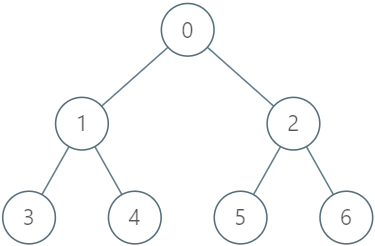
输入:
["LockingTree", "lock", "unlock", "unlock", "lock", "upgrade", "lock"]
[[[-1, 0, 0, 1, 1, 2, 2]], [2, 2], [2, 3], [2, 2], [4, 5], [0, 1], [0, 1]]
输出:
[null, true, false, true, true, true, false]

解释:
LockingTree lockingTree = new LockingTree([-1, 0, 0, 1, 1, 2, 2]);
lockingTree.lock(2, 2);    // 返回 true ,因为节点 2 未上锁。
                           // 节点 2 被用户 2 上锁。
lockingTree.unlock(2, 3);  // 返回 false ,因为用户 3 无法解锁被用户 2 上锁的节点。
lockingTree.unlock(2, 2);  // 返回 true ,因为节点 2 之前被用户 2 上锁。
                           // 节点 2 现在变为未上锁状态。
lockingTree.lock(4, 5);    // 返回 true ,因为节点 4 未上锁。
                           // 节点 4 被用户 5 上锁。
lockingTree.upgrade(0, 1); // 返回 true ,因为节点 0 未上锁且至少有一个被上锁的子孙节点(节点 4)。
                           // 节点 0 被用户 1 上锁,节点 4 变为未上锁。
lockingTree.lock(0, 1);    // 返回 false ,因为节点 0 已经被上锁了。
提示:
n == parent.length2 <= n <= 2000- 对于
i != 0,满足0 <= parent[i] <= n - 1 parent[0] == -10 <= num <= n - 11 <= user <= 104parent表示一棵合法的树。lock,unlock和upgrade的调用 总共 不超过2000次。
解法
方法一:DFS
我们定义以下几个变量:
locked:记录每个节点的锁定状态,其中locked[i]表示节点i的锁定状态,如果节点i未被上锁,则locked[i] = -1,否则locked[i]为锁定节点i的用户编号。parent:记录每个节点的父节点。children:记录每个节点的子节点。
调用 lock 函数时,如果节点 num 未被上锁,则将节点 num 上锁,返回 true,否则返回 false。
调用 unlock 函数时,如果节点 num 被上锁且上锁的用户编号为 user,则将节点 num 解锁,返回 true,否则返回 false。
调用 upgrade 函数时,我们首先判断节点 num 及其祖先节点是否被上锁,如果是,则返回 false。否则,我们判断节点 num 的子孙节点是否有被上锁的,如果没有,则返回 false。否则,我们将节点 num 及其子孙节点解锁,然后将节点 num 上锁,返回 true。
时间复杂度方面,初始化和 upgrade 函数的时间复杂度均为 O(n),而 lock 和 unlock 函数的时间复杂度均为 O(1)。空间复杂度 O(n)。其中 n 是节点的数量。
Python3
class LockingTree:
    def __init__(self, parent: List[int]):
        n = len(parent)
        self.locked = [-1] * n
        self.parent = parent
        self.children = [[] for _ in range(n)]
        for son, fa in enumerate(parent[1:], 1):
            self.children[fa].append(son)

    def lock(self, num: int, user: int) -> bool:
        if self.locked[num] == -1:
            self.locked[num] = user
            return True
        return False

    def unlock(self, num: int, user: int) -> bool:
        if self.locked[num] == user:
            self.locked[num] = -1
            return True
        return False

    def upgrade(self, num: int, user: int) -> bool:
        def dfs(x: int):
            nonlocal find
            for y in self.children[x]:
                if self.locked[y] != -1:
                    self.locked[y] = -1
                    find = True
                dfs(y)

        x = num
        while x != -1:
            if self.locked[x] != -1:
                return False
            x = self.parent[x]

        find = False
        dfs(num)
        if not find:
            return False
        self.locked[num] = user
        return True


# Your LockingTree object will be instantiated and called as such:
# obj = LockingTree(parent)
# param_1 = obj.lock(num,user)
# param_2 = obj.unlock(num,user)
# param_3 = obj.upgrade(num,user)
Java
class LockingTree {
    private int[] locked;
    private int[] parent;
    private List<Integer>[] children;

    public LockingTree(int[] parent) {
        int n = parent.length;
        locked = new int[n];
        this.parent = parent;
        children = new List[n];
        Arrays.fill(locked, -1);
        Arrays.setAll(children, i -> new ArrayList<>());
        for (int i = 1; i < n; i++) {
            children[parent[i]].add(i);
        }
    }

    public boolean lock(int num, int user) {
        if (locked[num] == -1) {
            locked[num] = user;
            return true;
        }
        return false;
    }

    public boolean unlock(int num, int user) {
        if (locked[num] == user) {
            locked[num] = -1;
            return true;
        }
        return false;
    }

    public boolean upgrade(int num, int user) {
        int x = num;
        while (x != -1) {
            if (locked[x] != -1) {
                return false;
            }
            x = parent[x];
        }
        boolean[] find = new boolean[1];
        dfs(num, find);
        if (!find[0]) {
            return false;
        }
        locked[num] = user;
        return true;
    }

    private void dfs(int x, boolean[] find) {
        for (int y : children[x]) {
            if (locked[y] != -1) {
                locked[y] = -1;
                find[0] = true;
            }
            dfs(y, find);
        }
    }
}

/**
 * Your LockingTree object will be instantiated and called as such:
 * LockingTree obj = new LockingTree(parent);
 * boolean param_1 = obj.lock(num,user);
 * boolean param_2 = obj.unlock(num,user);
 * boolean param_3 = obj.upgrade(num,user);
 */
C++
class LockingTree {
public:
    LockingTree(vector<int>& parent) {
        int n = parent.size();
        locked = vector<int>(n, -1);
        this->parent = parent;
        children.resize(n);
        for (int i = 1; i < n; ++i) {
            children[parent[i]].push_back(i);
        }
    }

    bool lock(int num, int user) {
        if (locked[num] == -1) {
            locked[num] = user;
            return true;
        }
        return false;
    }

    bool unlock(int num, int user) {
        if (locked[num] == user) {
            locked[num] = -1;
            return true;
        }
        return false;
    }

    bool upgrade(int num, int user) {
        int x = num;
        while (x != -1) {
            if (locked[x] != -1) {
                return false;
            }
            x = parent[x];
        }
        bool find = false;
        function<void(int)> dfs = [&](int x) {
            for (int y : children[x]) {
                if (locked[y] != -1) {
                    find = true;
                    locked[y] = -1;
                }
                dfs(y);
            }
        };
        dfs(num);
        if (!find) {
            return false;
        }
        locked[num] = user;
        return true;
    }

private:
    vector<int> locked;
    vector<int> parent;
    vector<vector<int>> children;
};

/**
 * Your LockingTree object will be instantiated and called as such:
 * LockingTree* obj = new LockingTree(parent);
 * bool param_1 = obj->lock(num,user);
 * bool param_2 = obj->unlock(num,user);
 * bool param_3 = obj->upgrade(num,user);
 */
Go
type LockingTree struct {
	locked   []int
	parent   []int
	children [][]int
}

func Constructor(parent []int) LockingTree {
	n := len(parent)
	locked := make([]int, n)
	for i := range locked {
		locked[i] = -1
	}
	children := make([][]int, n)
	for i := 1; i < n; i++ {
		children[parent[i]] = append(children[parent[i]], i)
	}
	return LockingTree{locked, parent, children}
}

func (this *LockingTree) Lock(num int, user int) bool {
	if this.locked[num] == -1 {
		this.locked[num] = user
		return true
	}
	return false
}

func (this *LockingTree) Unlock(num int, user int) bool {
	if this.locked[num] == user {
		this.locked[num] = -1
		return true
	}
	return false
}

func (this *LockingTree) Upgrade(num int, user int) bool {
	x := num
	for ; x != -1; x = this.parent[x] {
		if this.locked[x] != -1 {
			return false
		}
	}
	find := false
	var dfs func(int)
	dfs = func(x int) {
		for _, y := range this.children[x] {
			if this.locked[y] != -1 {
				find = true
				this.locked[y] = -1
			}
			dfs(y)
		}
	}
	dfs(num)
	if !find {
		return false
	}
	this.locked[num] = user
	return true
}

/**
 * Your LockingTree object will be instantiated and called as such:
 * obj := Constructor(parent);
 * param_1 := obj.Lock(num,user);
 * param_2 := obj.Unlock(num,user);
 * param_3 := obj.Upgrade(num,user);
 */
TypeScript
class LockingTree {
    private locked: number[];
    private parent: number[];
    private children: number[][];

    constructor(parent: number[]) {
        const n = parent.length;
        this.locked = Array(n).fill(-1);
        this.parent = parent;
        this.children = Array(n)
            .fill(0)
            .map(() => []);
        for (let i = 1; i < n; i++) {
            this.children[parent[i]].push(i);
        }
    }

    lock(num: number, user: number): boolean {
        if (this.locked[num] === -1) {
            this.locked[num] = user;
            return true;
        }
        return false;
    }

    unlock(num: number, user: number): boolean {
        if (this.locked[num] === user) {
            this.locked[num] = -1;
            return true;
        }
        return false;
    }

    upgrade(num: number, user: number): boolean {
        let x = num;
        for (; x !== -1; x = this.parent[x]) {
            if (this.locked[x] !== -1) {
                return false;
            }
        }
        let find = false;
        const dfs = (x: number) => {
            for (const y of this.children[x]) {
                if (this.locked[y] !== -1) {
                    this.locked[y] = -1;
                    find = true;
                }
                dfs(y);
            }
        };
        dfs(num);
        if (!find) {
            return false;
        }
        this.locked[num] = user;
        return true;
    }
}

/**
 * Your LockingTree object will be instantiated and called as such:
 * var obj = new LockingTree(parent)
 * var param_1 = obj.lock(num,user)
 * var param_2 = obj.unlock(num,user)
 * var param_3 = obj.upgrade(num,user)
 */